
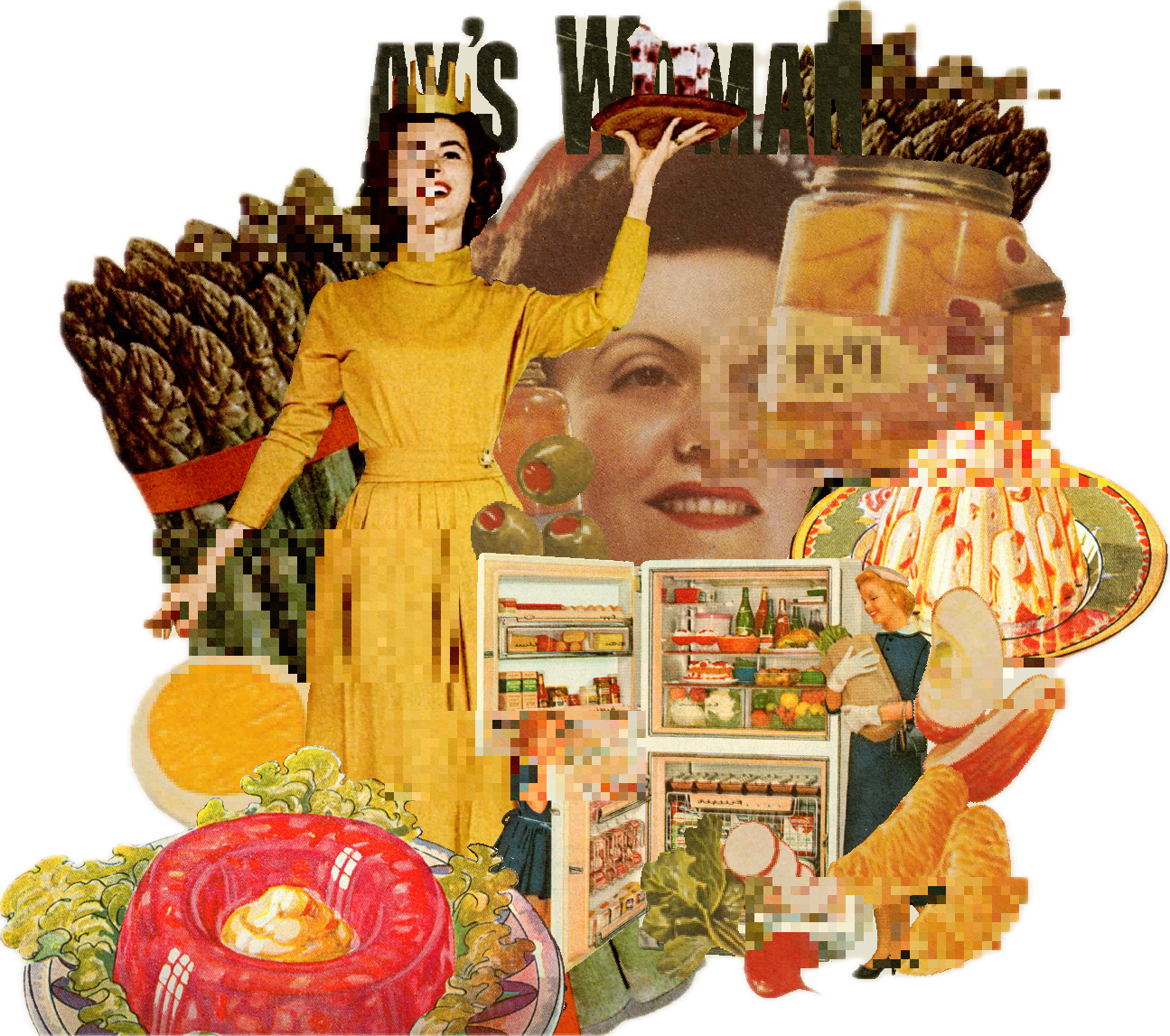
#Tradwives: TikTok's Biblically Feminine, Tech-Savvy Reactionaries
In Fall 2023, I took Media Sociology. For my final project, I decided to look at the phenomenon of Tradwives, examining how creators associated with the tradwife label articulate traditional gender roles, domestic labor, religious identity, and conservative ideology in digital spaces. I collected videos from the tradwife hashtag on TikTok and conducted content analysis. I was later invited to present the project at the Sociology department’s 2024 academic festival panel, and did a second round of data collection. What began as a personal curiosity became a systematic content analysis, focused on understanding how this digital micro-culture constructs gender, power, and identity through social media.
.
Background
Tradwives (a portmanteau of traditional and wife or traditional and housewife) are a specific subset of almost exclusively American women who have chosen to subscribe to strict, biblically-informed, “traditional” gender roles and expectations for women. These expectations require them to remain at home and tend to the needs of their husbands, children, and home (Kelsey-Sugg and Marin 2021). Notably, tradwives differ from other forms of housewives and stay-at-home mothers in their publication and promotion of their lifestyle via social media, as well as their valorization of a very specific niche of housewifery, often steeped in the aesthetics of 1950’s middle-America and “homesteading,” as well as generally reactive politics. It is the approach to and ideology surrounding their chosen tasks that sets #tradwives apart from other housewives (Sitler-Elbel 2021).
The #tradwife movement has gained some traction in the decade or so since the term first appeared online, especially among younger conservatives and Christians in the United States, with some seeing it as having the potential to move beyond a social media phenomenon and into a larger trend towards “traditional” lifestyles. However, it has also been the subject of criticism for its regressive views on women’s autonomy, conservatism, and links to the alt-right–unsurprisingly, a movement promoting a return to the American 1950s is not one overly concerned about the rights of people of color, or anyone outside of the archetypal white middle class at that time (Kellogg 2023). Additionally, the #tradwife focus on white motherhood has links to alt-right beliefs about the family and reproduction. While I had originally hoped to examine the responses to #tradwife content through comments and reaction videos on TikTok and the discourse surrounding the movement online, I quickly realized that it was more realistic to focus solely on the content of prominent #tradwife creators. This led me to an analysis of the messages and politics shared by #tradwives on TikTok. While the movement isn’t completely monolithic, I found an interestingly consistent set of themes throughout the content and creators I analyzed: reactive politics, a firmly Christian worldview, and the belief among creators that they are part of a larger social movement enabled through social media.
Methodology
Sampling
I collected my data from TikTok in two sampling periods: one in November-December 2023, and one in April 2024. I used a burner account to reduce algorithmic bias and selected from the top videos under #tradwife. I had to significantly filter the videos; I did not sample videos that were satirizing tradwives (of which there were many), and I selected tradwife videos where creators discussed their beliefs, practices, or motivations, and where gender roles, domestic labor, religion, or identity were explicitly addressed. Video styles such as “day in the life” were excluded.
Final Sample
My final sample was made of 25 videos from 14 accounts. The videos were posted between 2020-2024, from accounts with follower counts between 555,000 and 5,000 (average 86,000). All creators were married women in their 20s, all but one were white, 10/14 were mothers (non-mothers expressed that they hoped or planned to have children soon), and 10/14 were explicitly Christian–though with differing levels of intensity.
Coding and Content Analysis
I used qualitative coding to identify themes in the videos, focusing on text/audio/caption content. I then compiled these codes to see the similarities and difference across the dataset. I want to note that I did not do a complete content analysis of the aesthetics and actions portrayed in these TikToks. The movement’s use of aesthetics is complicated enough to be the focus of another paper, but I did notice some trends in the videos I analyzed that I feel should be included in this one. All the women I looked at wore modest, loose-fitting, “feminine” clothing, except one (@esteecwilliams) who wore notably more revealing dresses and necklines. Many #tradwife videos included references to 1950s aesthetics and style, both overtly and subtly, as well as pastoral depictions of farming and homesteading–often aspirationally. Finally, a large portion of the #tradwife content I looked at centered around specifically baking bread and other pastries or the desire to bake bread. This specific set of #tradwife aesthetics and activities is also part of what sets them apart from other housewives-these aesthetics are a clear romanticization of the “traditional” lifestyle many #tradwives aspire to, but few actually live.
Findings
“While the world continues to condemn traditional wives…I’ll continue to live my truth” #makewivesgreatagain
“I believe god created women to be soft, nurturing, empathetic carriers of life…I believe god created men to take care of and protect their families, and to cherish, lead, love and respect thier [sic] wives, and to be their best friend and safe place…..”
“This growing return to traditional values in our culture is SO encouraging for the future! I’m so happy to be a part of it! #proudtradwife.”
In my analysis of #tradwife content, I found three broad themes: 1) a strong trend of reactionism, 2) biblically-influenced perspectives, and 3) a belief among these #tradwife creators that they are part of a larger social media supported social trend. These themes highlight the trends noted in my literature review, which situate #tradwives at the unique intersection of conservatism, feminism, and online content creation.
Reactionary Conservatism
From the movement’s inception in responses to The Feminine Mystique, #tradwives are deeply reactionary. While the majority of the literature on tradwives focuses on the tensions between the concept of “choice feminism” and housewives, and indeed that is a major part of the movement, this reactionary streak also encompasses the conservative politics of the #tradwife movement as well as the ways that much of #tradwife content is based around “trolling” feminists or people that disagree with them. I have grouped discussions of choice, submission, and subservience along with regressive stances on gender roles and household dynamics under the reactionary theme.
Some but not all creators used the hashtag #antifeminism, along with similar hashtags like #feminismlied or #femininenotfeminist. At least one of the videos was a specific response to the backlash the creator (@homewithmadison) had received from feminists. As she says, although she has chosen to be a stay-at-home mother, she is receiving DMs from feminists who disagree with her choices: “…I thought feminists supported all women, but I’m learning….that that’s not true at all…I’m currently pregnant and barefoot in the kitchen with my second, so, stay mad.” This video encapsulates a few aspects of #tradwife reactionism; the discourse around choice feminism and the concept that if tradwives are choosing to stay in the home they shouldn’t be criticized by feminists, the acceptance of female servitude and childbearing, the references to larger conservative trends, as well as the parting “stay mad” make it clear that Madison is both aware of and supporting these reactionary ideals, and utilizing them to “troll” feminists. Most anti-feminist sentiments are not nearly so confrontational, though. Many videos refer to the vague “world” which has apparently deemed it impossible to remain at home: “in a world full of women teaching their children that their only goal is to go to university…” or “we live in a day and age where traditional homemaking has been forgotten about and even looked down upon…” or “while the world continues to condemn traditional wives..” are sentiments shared among many of the #tradwives I examined which place housewifery as some sort of endangered profession, a counter-cultural resistance movement against the seemingly hegemonic powers of feminism and progressive politics in general. What these sentiments conveniently avoid, of course, are the economic factors that might be impacting the existence of housewives, the autonomy of other women, and that progressivism is not, in fact, hegemonic in today’s society. In the #tradwife context, a return to “the good old days” is preferable to the ills of modernity–a reminder again of the reasons why the movement has been so tightly intertwined with that of the alt-right.
Similarly, there were varying levels of conservatism expressed across my sample. Some creators didn’t label their politics but labeled themselves as Christian antifeminists. Others labeled themselves as both conservative and “crunchy” (an intersection that deserves a more in-depth review). The most political creators used hashtags like #makewivesgreatagain to indicate their politics. If there was an argument to be made for #tradwives as benign and insular communities, these associations are a reminder that #tradwives are more than aware of their position in the broader conservative movement.
Biblical Perspectives and Gender
Perhaps unsurprisingly, much of #tradwives’ reactionary politics stem from a conservative Christian worldview. While there were slight variations in the ways that the #tradwives I looked at talked about their faith, they are all Christian, and cite Christianity as the reason for their tradwifery. #Biblicalfemininity, #biblicalmarriage, along with specific references to #proverbs31woman/#proverbs31wife were common hashtags (Proverbs 31 being the chapter of the Old Testament which refers to the “ideal wife.”) A lack of Christianity (because of feminism) is seen as the reason for societal decline: “Marriage is falling apart because the God who created it has been left out of it, and an overall disconnect in the home, because the one who has been created to nurture it has been empowered to neglect it.” Some posts combine the slightly contradictory elements of Christianity and women’s choice: “It’s a lifestyle we choose because it’s our God-given role.” In other cases, Christianity explains a tradwife’s own lifestyle choices as well as her condemnation of other’s: “I believe abortion is murder. God creates precious life in the womb of a woman, it’s not for us to choose to end a life he created.” Even when not so explicitly stated, it is biblical conceptions of women’s femininity, labor, need for reproduction, and subservience to their husbands that underpin the #tradwife lifestyle.
Lifestyle Movements
#Tradwives are a movement defined by their relationship to social media and technology as much as they are by their goals to return to “tradition.” In my sampling and analysis, I couldn’t help but wonder about the existence of offline tradwives and their invisibility compared to those that I found online. Some of the #tradwives I looked at have parlayed their social media presences into side hustles through blogs, YouTube channels, and monetization (often with the justification that this job is an acceptable one, as you can remain at home while doing it). A major part of many #tradwives’ content is their promotion of the lifestyle, either through raising their children to follow in their footsteps, or by proselytizing through social media. One woman, @andreandsolie, explains that “being a homemaker will be option A for our daughters…..we are not going to raise our daughters on the very small off-chance that they might not get married…And that is how you really change the generations, by instilling the legacy of homemaking into your children.” Another notes: “I’m teaching my daughter that it’s perfectly acceptable to depend on a man. That being a homemaker is the number 1 career she should strive for & that serving her husband & bearing children will be her greatest joy.” It’s unsurprising that much of this control focuses around #tradwives’ daughters, rather than their sons. In a turn to the broader movement, @Mckennamotely states “this growing return to traditional values in our culture is SO encouraging for the future! I’m so happy to be a part of it! #proudtradwife.” Yet again, these sentiments indicate an awareness among #tradwives of the goal of sharing tradwife content.
.
Conclusion
While TikToks might not be an incredibly formal type of media, they are nonetheless one of the major ways that information is currently exchanged, especially among younger generations. As we’ve discussed in class, social media have a powerful capacity to share information and ideology, be it progressive or regressive. Moreover, it is also a place where non-celebrities can share their opinions and lifestyles, and gain followers and material benefits from doing so–all while growing a community of like-minded women. #Tradwives are an example of the democratizing nature of social media as well as its ability to perpetuate regressive ideology and recruit others to the same ideals. They also follow the historical trend of media being a place of critique and discussion by feminists and other progressive social movements.
I have found that the recurring themes in my content analysis of #tradwives closely follow the noted themes in the existing literature surrounding the movement. While #tradwives can be deeply contradictory and at times jarringly regressive, they are nonetheless consistent in their aesthetics, political and social messaging, and modes of communication (sharing their lives through social media). Perhaps this speaks to the nature of this movement as one that is inseparable from its relationship to social media, and the interconnected nature of #tradwives online.
Despite the backlash #tradwives have garnered online, they remain an under-researched group within academia. While we have an idea of who #tradwives actually are as a demographic, we lack the reporting and research to solidify any analysis of the group beyond their online personas. The formation of the movement, #tradwives’ politics and messaging, and links to the alt-right are all subjects worthy of a more formal interrogation, especially as national and global politics are reflecting a similar reactionary trend–while this is happening in the news media, it hasn’t made its way to sociological research. #Tradwives are a manifestation of conservative anxieties about the modern world. While they are just one facet of new American conservatism and the alt-right, exploring the links between the two movements offers an opportunity to better understand the workings of conservatism as a whole, as well as what makes it attractive to younger generations. However, it also remains to be seen if #tradwives will retain their place in conservative spaces in the coming years, and if their relationship to the social media platforms that spawned them will evolve.