
Digital Diets: Food and Politics on TikTok
Inspired by my small-scale research on Tradwives, I was given the opportunity to examine the relationships between food content and political ideology through Skidmore’s faculty-student collaborative summer research program. Over 5 weeks in the summer of 2025, I collected content from food influencers on TikTok and conducted content analysis to try to understand the ways that food content (videos on cooking, grocery shopping, as well as dietary, health, and lifestyle advice) can shed light on the political and cultural messages present in discourses on what and how we eat. While many creators present their content as apolitical, their discussions of purity, health, natural living, and distrust of institutions carry strong ideological signals. By analyzing these narratives, the project asks how food content shapes people’s understanding of responsibility, identity, and potential for change.
Thank you to Professor Hou for all of her guidance and insight through this research process–I truly could not have done this without her!
Background
Research Questions
- Can we see political leanings expressed in ‘apolitical’ lifestyle/food content?
- How are ideological messages conveyed through food content on social media?
- What problems are identified by influencers in our food systems, and what are the proposed solutions?
- How might this impact broader food/political discourses on/offline?
Online spaces have become the main way that food information is created and shared. In this social-media-dominated environment, food influencers become thought leaders, with real-world impacts on the way we think about food, and what, how, and why we eat the things we do. Influencers sharing videos and content about their lifestyle often present as “apolitical” for a myriad of reasons, such as attracting a wider audience, monetizing their content, or simply because they don’t feel strongly about politics. However, this does not negate the fact that ideological messages are often conveyed, implicitly or explicitly, in influencers’ content–especially when it comes to food. Existing literature on political leanings and dietary choices has found that people with conservative politics are less likely to eat plant-based or choose imperfect produce, and are deterred by climate-focused advertising. There are also existing connotations of plant-based diets as left-leaning. However, there is a lack of current research on what a “conservative” diet looks like, and a lack of discussion on the role of “non-political” creators’ implicit messaging through their content. Additionally, most studies on political messaging in any online content are quantitative, slightly out-of-date, and focus on text-based platforms such as blogs and Twitter (now X), as opposed to more recent video-based platforms like TikTok or Instagram Reels.
Methodology
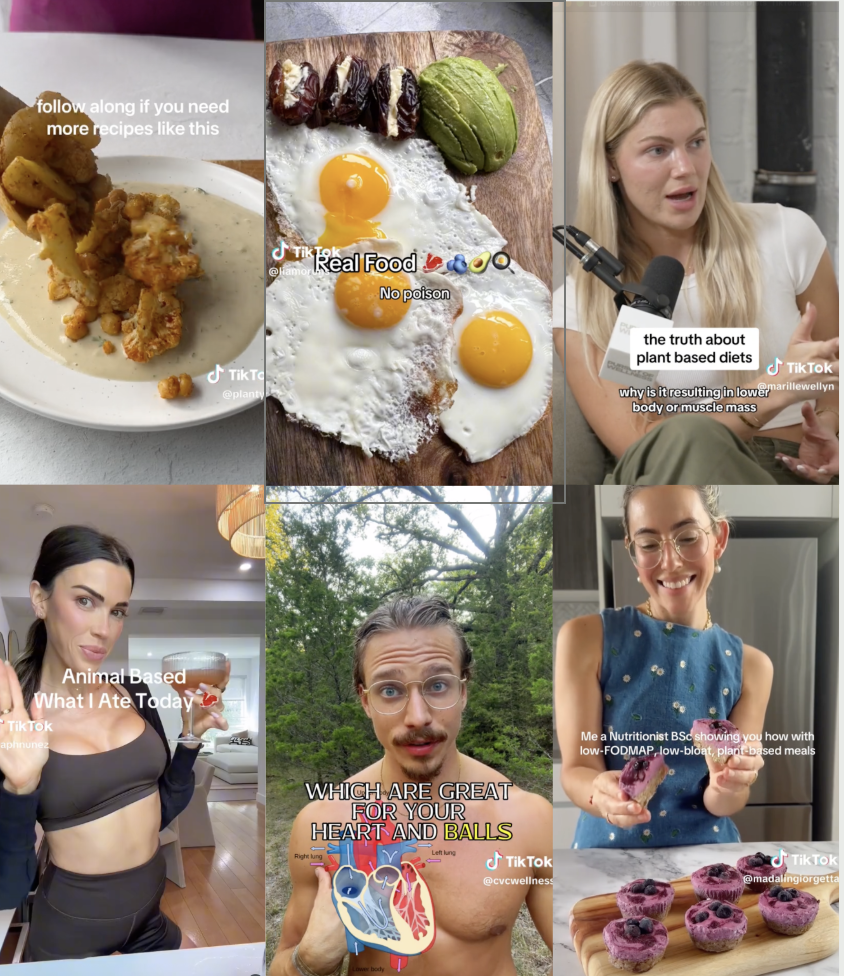
Screenshots from sampled content
Sampling
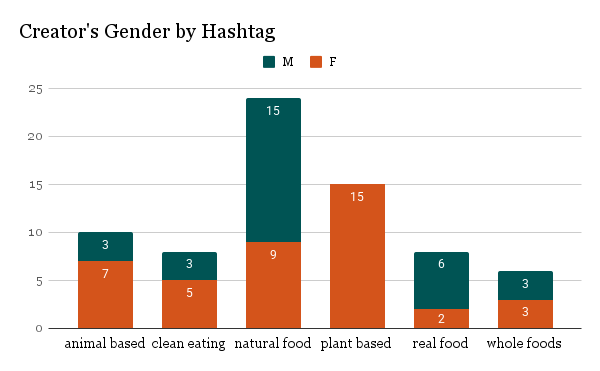
Data collection took place between June 4 and June 6, 2025. We began with a purposive sampling strategy to identify a hashtag broad enough to capture a wide range of food-content creators without pulling in unrelated material. We selected #naturalfood and collected the top 50 videos using a new anonymous account to avoid algorithmic personalization. From this initial set, we identified the most frequently co-occurring hashtags—#realfood, #animalbased, #plantbased, #wholefoods, and #rawfoods—and sampled an additional 25 videos from each to capture the breadth of this online ecosystem. For each video, we recorded: the video itself, transcripts, captions and on-screen text, number of likes, posting date, creator account, follower count, and hashtags used. We then applied exclusion criteria, removing content from: accounts with under 10,000 followers (the threshold for TikTok monetization), AI-generated or automated accounts, aggregate or compilation accounts, and duplicate videos. This produced a final sample focused on individual creators who actively participate in and benefit from the food-content creator economy.
Political Categorization
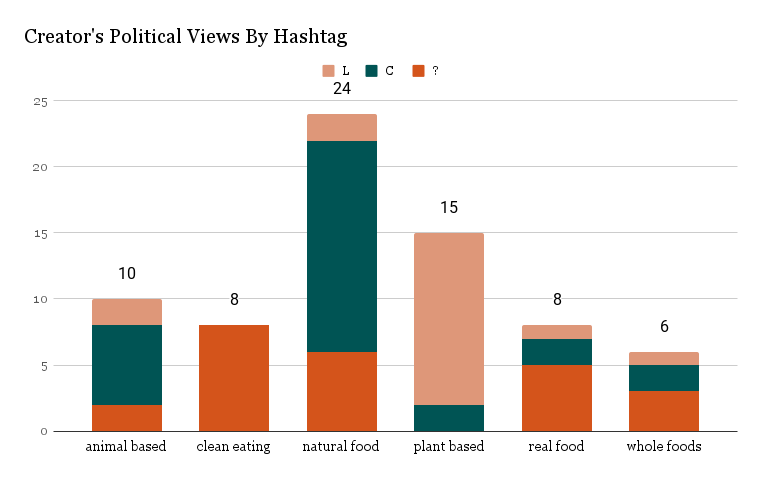
We next categorized creators according to their political expression. Many accounts included explicit political content either in their own videos or in their reposts, such as support or critique of political candidates, or positions on issues including LGBTQ+ rights, abortion, women’s rights, and climate change. When explicit content was absent, we examined implicit political cues, including: reposts of conservative figures (e.g., RFK Jr., Charlie Kirk, Joe Rogan), tradwife or anti-feminist content, or anti-vaccine content.
Importantly, many creators could not be clearly classified as “liberal” or “conservative,” even when ideological cues were present. It is also important to note that not being able to definitively categorize a creator’s political views does not mean that they (or their content) is “apolitical.” We randomly sampled 25 videos from the “uncategorized” creators to ensure they were still represented in the data.
Final Sample
The final sample consisted of 71 videos from 54 accounts: 19 “liberal” videos from 10 accounts, 28 “conservative” videos from from 22 accounts, and 24 “uncategorized” videos from 23 accounts.
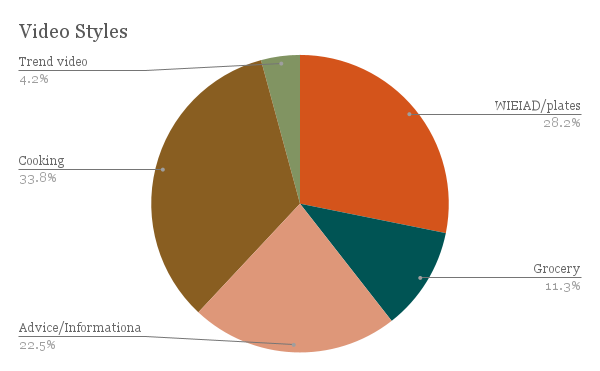
Qualitative Coding
Once I had completed data collection I began the process of qualitatively coding the data. I compiled the captions, transcripts, and video text from each video (I decided not to code the visual content of the videos) and conducted two rounds of coding. The first pass focused on identifying common motifs, shared language used by creators, and different messaging around food, both explicit and implicit. During this process I considered the context of these videos and what factors might be impacting the messages being conveyed; creators might choose to use language differently or focus on specific issues because of algorithmic, audience, and/or profit incentives. I also kept the audience of these videos in mind when creating non-biased codes. I cross-checked these codes with my professor to improve reliability, and built a codebook based on these themes. I then conducted a second round of coding using this framework.
I also conducted an (admittedly small-scale) quantitative analysis based on food labels that appeared repeatedly in the data, such as animal-based, plant-based, and grass-fed.
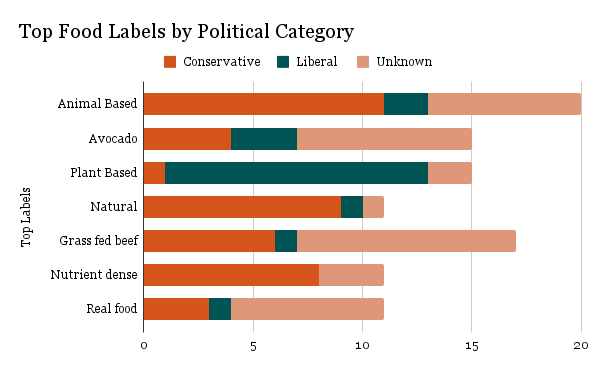
Themes
Liberal:
“Just eat real food !! Eat to nourish the mind and body and reduce chemicals, toxins and inflammations …Instead of teaching our kids what food is “healthy” or unhealthy, let’s teach them that food is… culture, fuel, creativity, nourishment, healing, celebrating, adventure, comfort, pleasure, connection, memories, self-care.”
“Nutrition should be fun and there should definitely be less people telling you ridiculous “nutrition” claims so they can sell you their expensive supplements in the guise that they care about your health. I have nothing to sell. And when it comes to nutrition, let’s make the focus about what you can add in to fit your needs.”
Uncategorized:
“Keep it simple. Eat whole-foods. wholefood – food that has been processed or refined as little as possible and is free from additives or artificial substances .….with some added supplements like protein to give us all of the nutrition we need throughout the day.”
“If you want to know how to clean eat in the most simple, most efficient way possible, I’m going to show you.”
Conservative:
“Three foods a men’s holistic nutritionist eats for relentless energy, high testosterone and a healthy physique.”
“We believe it’s important to create food standards in our homes. The rest of the outside world has no standards…..If we aren’t creating some form of standard in our homes then we will be consuming >50% of our diet from ultra-processed foods like the rest of the population does already.”
Institutional Distrust
Across ideologies, creators showed distrust in processed foods, which are seen as having lower nutritional quality, additives and/or “toxins”–set against “clean,” “real,” and “whole” foods, often defined through labels like “grass-fed,” “organic,” “raw,” and “single ingredient.” Individualized improved diets are put forward as alternatives to conventional medicine (mostly in conservative/uncategorized videos). Critiques of conventional agriculture and nutritional institutions were bipartisan, but relatively shallow. There was only one video that included a call to action against these institutions. In several conservative and uncategorized videos, individualized nutrition was portrayed as an alternative to conventional medicine—sometimes connected to anti-vaccine narratives or broader skepticism of medical authority. There were at least 4 instances of creators promoting supplements even as they denounced “processed” products, revealing some inconsistency in the definition and application of the term “processed.”
- Processed foods were consistently framed as harmful or nutritionally inferior.
- Positive food labels such as grass-fed,” “organic,” “raw,” and “single ingredient” serve as proxies for trustworthiness.
- Fear of toxins appears across all groups but is most prominent in uncategorized creators.
- Ultra-processed foods are heavily stigmatized, especially for containing seed oils, dyes, and sweeteners. The impacts of these processed foods are not always clearly explained.
You Are What You Eat
Creators frequently tied eating practices to personal identity, discipline, and self-improvement. Diet becomes a lifestyle, and lifestyle becomes part of personal branding. Across ideologies, food practices and lifestyle choices function as identity markers.
- Self-discipline and adherence to strict diets are emphasized most in conservative and uncategorized content, but is also present in some liberal videos.
- Physical transformation is prominent in conservative and uncategorized videos, less so in liberal videos.
- Biohacking and optimization frame food as a lever for improving testosterone, fertility, hormonal balance, and physical performance, especially in conservative spaces.
- Food is gendered in conservative content, with different diets being used to promote testosterone, physical strength, fertility, and/or hormonal health
Meta-Level Influencers
Creators across ideological groups participate in recognizable influencer behaviors referencing other diets, anticipating critiques of their own content, and engaging in broader online discourses, exhibiting a level of intercommunity awareness. All creators promoted themselves in some way–general engagement online, tagging/mentioning brands (unsponsored), brand collaborations (sponsored), and even promoting their own products. Notably, only conservative creators explicitly promoted their own products, though this sample was small.
- Community-building through dietary labels (“clean eating,” “animal-based,” “whole food”) and inclusion/exclusion language.
- Self-promotion including tagging brands, collaborating with other creators, and promoting their own products–this is a source of income for many creators.
- Testimonial authority is dominant, with personal experience standing in for scientific validation.
- Scientific studies, when referenced, are often selectively cited or misinterpreted.
- Liberals show slightly more explicit institutional authority, but still exhibit misinformation.
Food Itself
- Ease was the most common theme across all political categorizations and codes–simple, quick, and reliable recipes and diets are emphasized
- Food taste was secondary to ease and efficiency, with it more often being used as a way to highlight repeatability, health, or benefits rather than being focused on as a reason to eat a specific type of food/recipe
- Cost of food or specific diets is only addressed in liberal videos and 1 conservative video, despite the fact that many “natural” food labels and animal-based diets can come with additional costs compared to plant-based diets
- Accessibility of labels such as “local” are not considered, and was surprisingly (to me) underrepresented
Conclusion
Overall Findings
We found that this online space is dominated by lifestyle content with a (possibly deliberate) lack of overt politics. Many themes were represented across the political spectrum–generally, there seems to be shared distrust and skepticism towards the current industrialized agricultural system and institutional medical/nutritional knowledge. Influencers promoted individualized solutions–this distrust isn’t seen as a structural political issue, or at least isn’t contextualized as such, despite the fact that it is a potential point of mobilization. In this framing, the individual body is the point of reference and potential change–you may not be able to fix “the system,” but you can optimize yourself. There are some positives to this; the emphasis on agency and self-control seemed to take preference over blaming or shaming other groups. However, it also seems to limit the potential for collective action and bipartisan collaboration on shared critiques of our food systems.
Limitations
There were a few notable limitations to this research; our coding strategies were imperfect, and in many cases political lean could not be determined. Due to time constraints, we only focused on the text content of the videos. There was also limited inter-coder reliability and potential bias, since the majority of the coding was conducted by one person. Content analysis as a qualitative method is also limited. Although we considered the performative nature of online content, the role of algorithms, and possible social and financial incentives behind creators’ decisions of content, tone, word choice, we did not interview them directly. Further research in this field could consider visual content, community and network analysis within the lifestyle niche, changes in trends and food content over time, and the creator’s own interpretations of their work within the field.